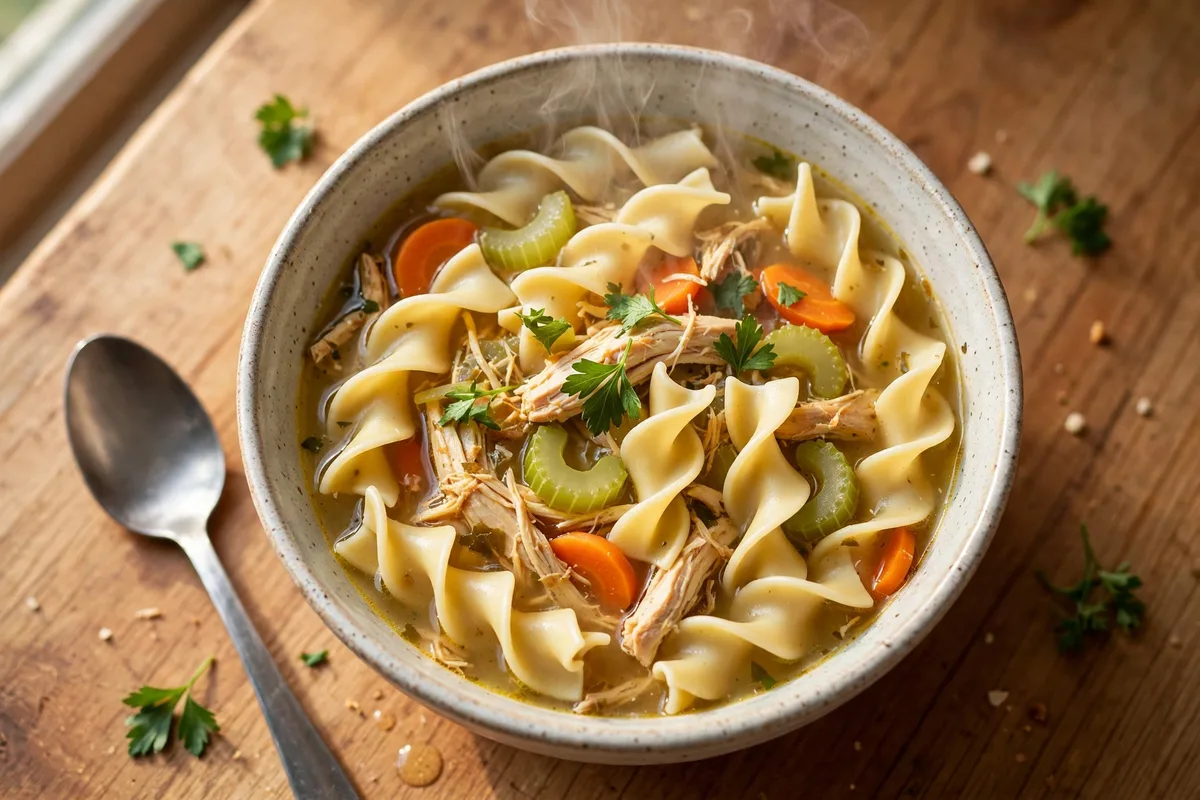
One-Pot Chicken Noodle Soup (30 Minutes)
When you need comfort in a bowl and you need it tonight, this one-pot chicken noodle soup is the answer. Tender chicken breasts poach right in the broth, wide egg noodles cook in the same pot, and the whole thing comes together in about 30 minutes — no leftover chicken, no canned chicken, no second pot to wash.
Everything happens in one pot: the chicken, the vegetables, the noodles, the broth. You start by softening onion, carrots, and celery in a little olive oil, then pour in the broth, add the chicken breasts and a bay leaf, and let the soup simmer until the chicken is cooked through. The chicken comes out, gets shredded, and goes straight back in with the noodles. Ten minutes later, dinner is ready — a clear, golden broth, soft vegetables, silky noodles, and plenty of shredded chicken in every spoonful.
This version is built for real weeknights. The ingredients are simple pantry and produce staples, the steps are short, and the timing is honest: about 10 minutes of prep and 20 minutes of cooking. It makes six servings, so there is enough for the family tonight and a container or two for lunch tomorrow. And if you want to stock the freezer, the soup freezes beautifully — just leave the noodles out until serving day.
Why This Recipe Works
The chicken cooks in the broth. Poaching the chicken breasts directly in the simmering broth does two jobs at once: the chicken stays tender because it cooks gently, and the broth picks up flavour from the chicken as it cooks. No separate cooking, and no need to rely on leftover or rotisserie chicken.
One pot, start to finish. The vegetables soften in the pot, the broth and chicken go in next, and the noodles cook in the finished soup. One pot means less washing up.
Wide egg noodles, cooked in the soup. Wide egg noodles are the classic choice: they stay silky, hold their shape in hot broth, and soak up just enough flavour. Cooking them in the pot means they absorb the seasoned broth instead of plain water.
Simple seasoning, done right. Onion, carrots, celery, garlic, thyme, and a bay leaf are all this soup needs. A squeeze of lemon and a handful of fresh parsley at the end brighten the whole pot.
It fits a busy evening. The total time is about 30 minutes from the first chop to the table, and most of that is hands-off simmering.
Ingredients
Servings: 6. Prep 10 minutes (estimate). Cook 20 minutes (estimate). Total 30 minutes (estimate).
- 1 tablespoon olive oil — for softening the vegetables; any neutral cooking oil works.
- 1 medium yellow onion, diced — about 1 cup; the base of the soup's flavour.
- 3 medium carrots, peeled and sliced into ¼-inch rounds — about 1½ cups; cut them evenly so they cook at the same rate.
- 3 celery stalks, sliced — about 1 cup; the classic aromatic backbone with the onion and carrots.
- 3 cloves garlic, minced — add it after the other vegetables so it does not burn.
- 8 cups low-sodium chicken broth — low-sodium lets you control the salt.
- 1½ lb boneless, skinless chicken breasts — about 2 large breasts; they poach in the broth and shred easily.
- 2 teaspoons fresh thyme leaves (or ½ teaspoon dried thyme).
- 1 bay leaf — adds a subtle background depth; remove it before serving.
- 1 teaspoon kosher salt, plus more to taste — start here and adjust at the end, since broth saltiness varies.
- ½ teaspoon black pepper, plus more to taste.
- 6 oz wide egg noodles — about 3 cups dry; the classic noodle for this soup.
- ¼ cup chopped fresh parsley — stirred in at the end for colour and freshness.
- Juice of ½ lemon (optional) — a small squeeze brightens the broth; add it off the heat.
Equipment
A large pot or Dutch oven (at least 5 quarts), a cutting board and knife, tongs, two forks for shredding, and a ladle.
Instructions
- Soften the vegetables (about 5 minutes). Heat the olive oil in a large pot over medium heat. Add the diced onion, carrots, and celery, and cook, stirring occasionally, for about 4 to 5 minutes, until the onion turns translucent and the vegetables start to soften. The carrots should still be firm — they will finish cooking in the broth.
- Add the garlic (about 30 seconds). Stir in the minced garlic and cook for about 30 seconds, just until fragrant. Do not let the garlic brown, or it can turn bitter.
- Pour in the broth and add the chicken (about 1 minute). Pour in the 8 cups of chicken broth, scraping up any browned bits from the bottom of the pot. Add the chicken breasts, thyme, bay leaf, salt, and pepper. The chicken should be mostly submerged in the broth.
- Bring to a simmer and cook the chicken (about 12 to 15 minutes). Increase the heat to medium-high and bring the soup to a gentle simmer — small bubbles breaking at the surface, not a rolling boil. Reduce the heat to medium-low, partially cover the pot, and simmer for 12 to 15 minutes, until the chicken is cooked through. The chicken is done when it reaches an internal temperature of 165°F (74°C) at the thickest part, measured with a food thermometer. Skim off any foam that rises to the surface.
- Shred the chicken (about 2 minutes). Use tongs to lift the chicken breasts out onto a cutting board. Remove and discard the bay leaf. Shred the chicken with two forks into bite-size pieces, then return the shredded chicken to the pot.
- Cook the noodles (about 6 to 8 minutes). Stir in the 6 oz of wide egg noodles. Bring the soup back to a gentle simmer and cook for 6 to 8 minutes, or until the noodles are tender. Stir once or twice so the noodles do not stick together or to the bottom of the pot.
- Finish and season (about 1 minute). Turn off the heat. Stir in the chopped parsley and the lemon juice, if using. Taste the broth and add more salt and pepper as needed. Ladle into bowls and serve hot.
Expert Tips
Keep the simmer gentle. A rolling boil makes chicken breasts tough and dry and can cloud the broth. You want a lazy simmer with small bubbles, and the chicken will come out tender every time.
Cut the vegetables evenly. Carrots cut to the same thickness cook at the same rate, so you do not end up with some pieces crunchy and others mushy.
Do not overcook the noodles. Egg noodles go from tender to soft quickly, and they keep absorbing broth as the soup sits. Cook them just until tender.
Season at the end. Broth brands vary a lot in saltiness, so the 1 teaspoon of kosher salt is a starting point, not a final amount. Taste after the noodles go in, and adjust the salt, pepper, and lemon then.
Use a thermometer. The surest way to know the chicken is done is an internal temperature of 165°F (74°C) at the thickest part. Guessing by colour alone is unreliable, and a thermometer takes seconds.
Shred, do not dice. Shredded chicken catches the broth and noodles better in each spoonful, and it gives the soup the homestyle texture people expect. Two forks and a warm cutting board are all you need.
Variations and Substitutions
Chicken thighs instead of breasts. Boneless, skinless chicken thighs work just as well and stay very tender; use the same 1½ lb and cooking time, checking for 165°F (74°C) at the thickest part.
Different noodles. Medium egg noodles, rotini, or small shells can replace the wide egg noodles. Adjust the cooking time to the package directions and keep the quantity at about 6 oz.
Add more vegetables. A cup of frozen peas stirred in with the noodles, or a handful of sliced mushrooms added with the onion and carrots, both fit the soup well. Add peas in the last 2 minutes so they stay bright.
Gluten-free option. Use your favourite gluten-free noodles and check that your broth is labelled gluten-free. Cook the noodles separately if the package warns they release a lot of starch, then add them to the bowls and ladle the soup over the top.
A little heat. A pinch of red pepper flakes stirred in with the garlic adds gentle warmth without changing the soup's classic flavour.
Common Mistakes to Avoid
Boiling the chicken hard. A vigorous boil tightens the proteins and dries the chicken out. A gentle simmer is the whole secret to tender poached chicken.
Adding the noodles too early. Noodles added with the chicken will overcook long before the chicken is done. They go in last, after the chicken is shredded, and cook in just 6 to 8 minutes.
Skipping the final taste. Broth, chicken, and noodles all affect the salt level. Always taste after the noodles are in and adjust the salt, pepper, and lemon before serving.
Serving Suggestions
Serve the soup hot in wide bowls with a sprinkle of extra parsley on top. Crusty bread, a warm baguette, or buttered dinner rolls are the classic partners — good for dipping and for soaking up the broth. Saltine crackers or oyster crackers work just as well and are what many families reach for on a sick day.
For a fuller meal, add a simple side salad or a grilled cheese sandwich cut into strips for dipping. A wedge of lemon on the side lets everyone brighten their own bowl.
Storage and Freezing
Refrigerator: Cool the soup to room temperature within 2 hours, then store in airtight containers in the refrigerator for up to 4 days. The noodles will absorb broth and soften as the soup sits — that is normal. Reheat gently on the stove over medium heat until steaming hot, adding a splash of broth or water if the soup has thickened.
Freezer: This soup freezes well, but the noodles do not. For the best results, freeze the soup without the noodles: cook the soup through the chicken step, cool it, and freeze in portions for up to 3 months. To serve, thaw overnight in the refrigerator, bring to a simmer, and cook fresh noodles in it for 6 to 8 minutes.
Reheating: Reheat only the portion you plan to eat, and heat it until steaming hot throughout. Avoid repeatedly reheating the whole pot, which overcooks the noodles and the chicken.
Frequently Asked Questions
Can I use leftover or rotisserie chicken instead of raw chicken breasts?
Yes. Simmer the vegetables in the broth for about 10 minutes, then stir in about 3 cups of shredded cooked chicken with the noodles and cook until the noodles are tender. Cooking the chicken in the broth, as written, gives a richer result, but the shortcut works well.
How do I keep the noodles from getting mushy?
Cook the noodles only until just tender, and serve the soup right away. Noodles keep absorbing liquid off the heat, so letting them sit in hot broth is the main cause of mushiness. If you are making the soup ahead, cook the base without noodles and add them just before serving.
Can I freeze chicken noodle soup?
Yes, for up to 3 months — but freeze it without the noodles, which turn soft and break apart after freezing. Freeze the soup base of broth, vegetables, and shredded chicken, thaw overnight in the refrigerator, then cook fresh noodles in it when you reheat.
What is the best chicken for chicken noodle soup?
Boneless, skinless chicken breasts are the simplest choice: they poach quickly, shred easily, and keep the broth clear. Boneless thighs also work and are a little more forgiving if the soup simmers a minute or two longer. Either way, cook the chicken to 165°F (74°C).
Can I make this soup in a slow cooker?
Yes. Add the onion, carrots, celery, garlic, broth, chicken, thyme, bay leaf, salt, and pepper to the slow cooker and cook on low for 4 to 5 hours or high for 2 to 3 hours, until the chicken reaches 165°F (74°C). Shred the chicken, return it to the pot, stir in the noodles, and cook on high for about 20 to 30 minutes until tender.
Why is my broth cloudy?
The usual cause is boiling the soup hard, which churns up proteins and fat from the chicken. A gentle simmer keeps the broth clearer, and skimming the foam in the first few minutes helps. Cloudy broth is still perfectly fine to eat — it is a looks issue, not a safety one.
Is this soup good for a cold?
Chicken noodle soup is the classic sick-day food for a reason: it is warm, easy to eat, hydrating, and gentle on the stomach. This recipe makes no health or medical claims — it is simply a comforting, straightforward soup that is easy to make when you are not feeling your best.
Can I double this recipe?
Yes, in a pot of at least 8 quarts, doubling every ingredient including the broth and noodles. Cooking times stay roughly the same, though a larger pot takes a few minutes longer to reach a simmer. Check the chicken with a thermometer — 165°F (74°C) at the thickest part.
Nutrition
The following values are estimates only, calculated per serving (1 of 6) from the listed ingredients, and will vary with the broth brand, noodle brand, and exact chicken weight.
Approximately: 285 calories; 30 g protein; 28 g carbohydrates; 5 g fat; 2 g fibre; 620 mg sodium; 3 g sugar. The soup is a good source of protein and provides vegetables in every serving. To reduce sodium, use a no-salt-added broth and season lightly. To reduce carbohydrates, use fewer noodles or replace half the noodles with extra carrots and celery.
Related Recipes
If you like one-pot chicken soups, these are worth trying next. For a creamy, comforting bowl with rice instead of noodles, try our One-Pot Creamy Chicken and Rice Soup. For a richer, pot-pie-inspired version with a creamy broth and vegetables, see our One-Pot Chicken Pot Pie Soup. And for a version with a little southwestern warmth, try our One-Pot Chicken Tortilla Soup — all three come together in about 30 minutes in a single pot.