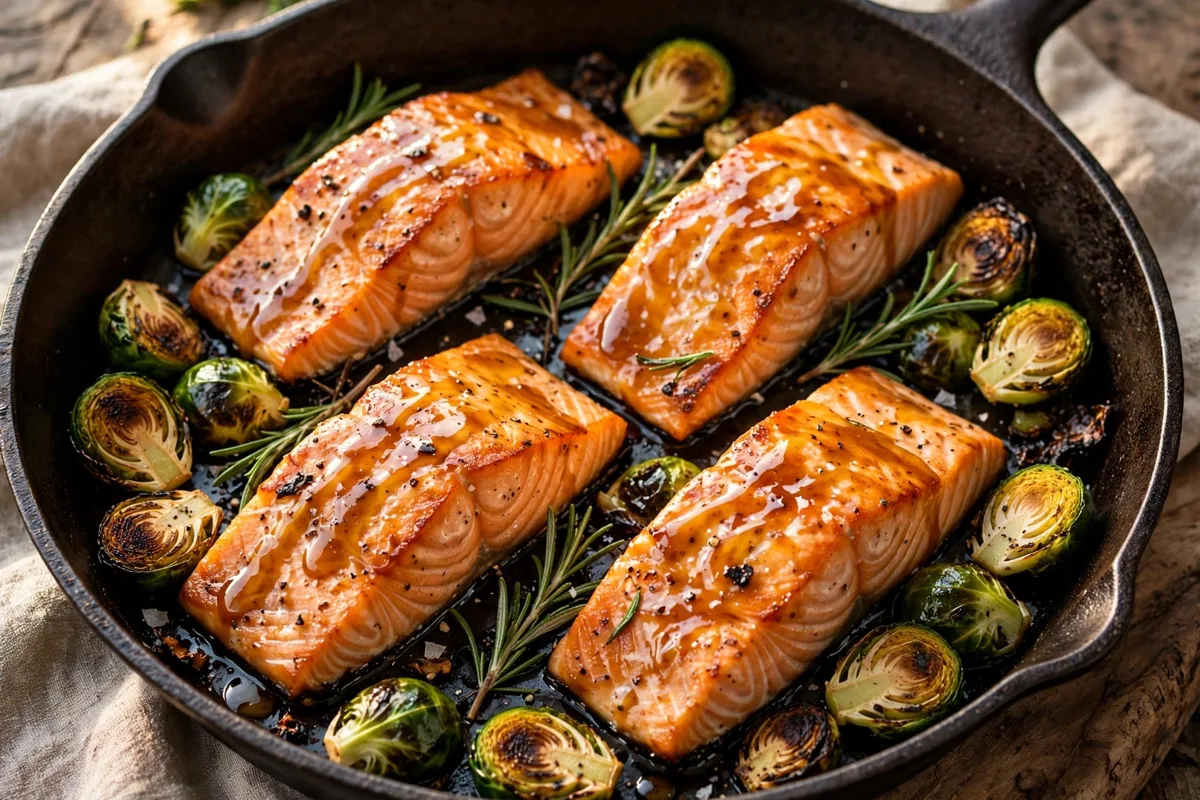
Maple-glazed salmon and Brussels sprouts, cooked start to finish in one skillet on the stovetop — no oven, no sheet pan, no second dish. The salmon sears skin-side down until the skin turns crisp and the flesh flakes cleanly, the halved Brussels sprouts blister in the same pan until their cut sides go dark and sweet, and a maple, Dijon, and soy glaze reduces right there in the skillet into something glossy enough to spoon over everything. Dinner is on the table in about 30 minutes, and the only thing to wash is the pan.
Most maple-glazed salmon and Brussels sprouts recipes online are sheet-pan recipes. They work, but they ask you to heat a whole oven and roast everything at one temperature even though salmon and sprouts do not want the same treatment. Salmon dries out while the sprouts are still catching up, or the sprouts come out pale while the salmon is already done. The skillet solves that: each ingredient gets its own turn in the pan, at the heat it actually needs, and the glaze is built from the browned bits left behind.
This is a late-fall dinner by design. Brussels sprouts are in season, maple sits naturally next to them, and the dish leans sweet-savory the way fall cooking does — without turning into dessert. The glaze balances real maple syrup, Dijon mustard, soy sauce, and garlic.
Prep time: 10 minutes (estimate)
Cook time: 20 minutes (estimate)
Total time: 30 minutes (estimate)
Servings: 4
Why this maple-glazed salmon and Brussels sprouts skillet works
The method is built around one idea: cook the salmon and the sprouts separately, in the same pan, in the right order. The salmon goes in first, skin-side down, into a properly hot skillet. Left alone for four to five minutes, the skin renders and crisps while the flesh cooks most of the way through from below. A short finish on the other side, two to three minutes, and it is done — moist inside, with crisp skin.
The sprouts go in next, cut-side down, into the same oil the salmon left behind. That oil is seasoned now, and the flat cut surface of each sprout half browns against the hot metal the way a roasted sprout browns in an oven. A brief covered steam with a splash of water finishes the centers without overcooking the leaves, for charred edges and tender middles in the same bite. If you put the sprouts in with the salmon, they would steam in the salmon's moisture and never brown.
The glaze is the third act, and it takes about two minutes. Maple syrup, Dijon mustard, soy sauce, and garlic go into the empty hot pan and bubble down into a syrup that coats a spoon. The salmon and sprouts go back in just long enough to get lacquered. Because the glaze is reduced in the pan rather than poured on raw, it clings instead of pooling, and the maple flavor reads as caramelized rather than just sweet.
Ingredients
- 4 salmon fillets (about 6 oz each), skin-on, pin bones removed if needed
- 1 lb Brussels sprouts, trimmed and halved lengthwise
- 1 tablespoon olive oil
- 1 tablespoon unsalted butter
- ¾ teaspoon kosher salt, divided
- ½ teaspoon freshly ground black pepper, divided
- ⅓ cup pure maple syrup
- 1 tablespoon Dijon mustard
- 1 tablespoon low-sodium soy sauce
- 3 cloves garlic, minced
- 1 tablespoon fresh lemon juice
- ¼ teaspoon red pepper flakes (optional, for gentle heat)
- 2 tablespoons water, for steaming the sprouts
- 1 tablespoon chopped fresh rosemary or parsley, for garnish
- Lemon wedges, for serving
A note on a few of these: use pure maple syrup, not pancake syrup — pancake syrup is mostly corn syrup and will not reduce into the same glaze. Skin-on salmon is the right choice here because the skin protects the flesh from the hot pan and turns crisp; if your fillets are skinless, reduce the first sear by about a minute. Cut the sprouts in half through the stem end so the leaves stay attached, and keep the halves roughly the same size so they cook evenly. Low-sodium soy sauce matters: regular soy sauce can push the glaze too salty once it reduces.
Instructions
- Pat the salmon fillets completely dry with paper towels and season both sides with ½ teaspoon of the salt and ¼ teaspoon of the pepper. In a small bowl, whisk together the maple syrup, Dijon mustard, soy sauce, garlic, and lemon juice. Set the glaze aside.
- Heat the olive oil in a large 12-inch skillet over medium-high heat until it shimmers, about 2 minutes. A cast-iron or stainless-steel skillet works best here.
- Place the salmon fillets skin-side down in the hot skillet, leaving space between them. Press each fillet down gently with a spatula for the first 10 seconds so the skin makes full contact with the pan. Cook undisturbed for 4 to 5 minutes, until the skin is golden and crisp and the flesh has turned opaque about two-thirds of the way up the side. Do not move the fillets while they sear — they will release from the pan on their own when the skin has crisped.
- Flip the salmon and cook 2 to 3 minutes more on the flesh side, until the fish flakes easily with a fork and an instant-read thermometer inserted into the thickest part reads 145°F (63°C), the USDA-recommended internal temperature for fish. Transfer the salmon to a plate. Leave the oil in the pan.
- Reduce the heat to medium. Add the butter to the same skillet and let it melt and foam. Place the Brussels sprouts cut-side down in a single layer, season with the remaining ¼ teaspoon salt and ¼ teaspoon pepper, and cook undisturbed for 4 to 5 minutes, until the cut sides are deeply browned. Resist the urge to stir — the browning only happens while they sit still.
- Pour in the 2 tablespoons of water, cover with a lid, and steam for 3 to 4 minutes, until the sprouts are just tender when pierced with a knife. Uncover and cook 1 minute more so any remaining water evaporates.
- Push the sprouts to the edges of the skillet and pour the maple glaze mixture into the center. Let it bubble for 1 to 2 minutes, stirring, until it thickens enough to coat the back of a spoon. It will look thin at first and then change quickly — watch it closely, because maple syrup goes from syrupy to burnt in under a minute at this heat.
- Return the salmon to the skillet, skin-side up. Spoon the glaze over the salmon and sprouts, sprinkle with the red pepper flakes (if using) and the chopped rosemary or parsley, and cook 30 seconds more. Serve immediately with lemon wedges.
Tips for the best maple-glazed salmon and Brussels sprouts
Dry the salmon like you mean it. Moisture is the enemy of crisp skin. Pat the fillets dry, then pat them again. If the skin is still damp when it hits the pan, it steams instead of searing.
Do not crowd the pan. Four fillets fit a 12-inch skillet with room to spare; if your pan is smaller, sear the salmon in two batches. The same goes for the sprouts — a single layer, cut-side down, is what gets them charred. Crowded sprouts steam, and steamed sprouts are the ones people say they do not like.
Let the glaze reduce, but do not walk away. The glaze needs only a minute or two to thicken, and maple syrup burns fast once the water is gone. Keep the heat at medium and stir until the glaze coats a spoon.
Watch the salmon, not the clock. Fillets vary in thickness, and a thick center-cut fillet needs a minute more than a thin tail piece. The thermometer is the reliable check: 145°F (63°C) at the thickest point.
Substitutions and variations
Different fish: arctic char and steelhead trout behave much like salmon in this recipe and take the same glaze well. Cod or halibut also work, but they are leaner and flake more easily — handle them gently and shorten the first sear by about a minute.
No soy sauce: tamari is the closest one-to-one swap and keeps the dish gluten-free. Coconut aminos work too but are sweeter, so reduce the maple syrup by a tablespoon if you use them.
Maple alternatives: honey makes a fine glaze in the same quantity, though it browns faster and tastes a little more floral. Brown sugar (3 tablespoons, dissolved in 2 tablespoons of water) is another option, but it lacks maple's woody note.
Other vegetables: green beans, blistered the same way as the sprouts, are the easiest swap and cook a minute faster. Sweet potato cubes need longer — give them the covered steam step first, then uncover and brown.
Dairy-free and gluten-free: the recipe is gluten-free as written if you use tamari instead of soy sauce. For dairy-free, replace the butter with a second tablespoon of olive oil.
What to serve with maple-glazed salmon and Brussels sprouts
The skillet is nearly a complete meal on its own — protein and a vegetable in one pan — so it needs very little alongside it. The best partner is something plain and starchy to catch the extra glaze: steamed rice, buttered orzo, or mashed potatoes all work.
If you like the one-pan format, this site has a growing set of skillet dinners built the same way. The one-pan balsamic chicken and Brussels sprouts skillet is the closest cousin — same vegetable, same 30-minute structure, a tangy balsamic glaze instead of maple. The one-pan honey garlic chicken and green beans runs on a similar sweet-savory glaze, and the one-pan sausage and sweet potato skillet is the fall-flavored option for nights when you want something heartier.
Storage, reheating, and make-ahead
Refrigerator: cool to room temperature (no more than 2 hours on the counter), then store the salmon and sprouts in an airtight container for up to 3 days. Keep any leftover glaze in the same container — it doubles as the reheating sauce.
Freezer: freezing is not recommended for this dish. Cooked salmon dries out noticeably after freezing and thawing, and the sprouts lose their charred texture.
Reheating: the skillet is best — warm over medium-low heat with a splash of water and the leftover glaze, covered, for 3 to 4 minutes until just heated through. The microwave works too, but use 50% power in 45-second bursts so the salmon does not overcook; high heat turns leftover salmon rubbery fast. The skin will not stay crisp on reheating either way.
Make-ahead: trim and halve the sprouts and whisk the glaze up to a day ahead, storing each separately in the refrigerator.
Maple-glazed salmon and Brussels sprouts FAQ
Do I really not need the oven? No. This is a true stovetop recipe. The salmon sears in the skillet, the sprouts blister and steam in the same pan, and the glaze reduces on the burner. A 12-inch skillet is the only pan you need — it is faster than preheating an oven and gives you more control over each ingredient.
Can I use frozen salmon? Yes, but thaw it completely first — overnight in the refrigerator is best. Partially frozen salmon will not sear properly, and the skin will not crisp. Once thawed, pat it very dry and proceed as written.
Why is my glaze burning? Almost always the heat is too high or the glaze is left too long. Maple syrup reduces fast once the water evaporates. Keep the burner at medium, stir constantly, and pull the pan off the heat the moment the glaze coats a spoon.
Can I use skinless salmon? Yes. Reduce the first sear to 3 to 4 minutes and flip very gently with a thin spatula, since skinless fillets are more delicate. You lose the crisp skin, but the flavor is the same.
How do I know the salmon is done? Two checks: it flakes easily when pressed with a fork, and an instant-read thermometer in the thickest part reads 145°F (63°C). The flesh should still look moist at the very center when you take it off the heat — it finishes cooking as it rests for a minute on the plate.
Can I double the recipe? Yes, but not in one pan. A doubled batch overcrowds the skillet, the salmon steams instead of searing, and the sprouts will not brown. Cook in two batches or use two skillets side by side, and double the glaze.
Is this recipe gluten-free? It is gluten-free if you use tamari instead of soy sauce. Standard soy sauce contains wheat, so check the label.
Nutrition (estimated, per serving, serves 4): about 500 calories, 26g fat, 24g carbohydrates, 36g protein. Calculated from ingredient label values; actual numbers vary.Recipe card
One-Pan Maple Glazed Salmon and Brussels Sprouts Skillet (30 Minutes)
Prep time: 10 minutes (estimate)
Cook time: 20 minutes (estimate)
Total time: 30 minutes (estimate)
Servings: 4
- 4 salmon fillets (about 6 oz each), skin-on; 1 lb Brussels sprouts, trimmed and halved
- 1 tbsp olive oil; 1 tbsp unsalted butter; ¾ tsp kosher salt, divided; ½ tsp black pepper, divided
- ⅓ cup pure maple syrup; 1 tbsp Dijon mustard; 1 tbsp low-sodium soy sauce; 3 cloves garlic, minced
- 1 tbsp fresh lemon juice; ¼ tsp red pepper flakes (optional); 2 tbsp water
- 1 tbsp chopped fresh rosemary or parsley; lemon wedges, for serving
- Pat salmon dry; season with ½ tsp salt and ¼ tsp pepper. Whisk maple syrup, Dijon, soy sauce, garlic, and lemon juice.
- Heat olive oil in a 12-inch skillet over medium-high heat until shimmering, about 2 minutes.
- Sear salmon skin-side down 4–5 minutes until the skin is crisp; flip and cook 2–3 minutes more until it flakes easily and reads 145°F (63°C). Transfer to a plate.
- Melt butter in the same skillet over medium heat. Sear sprouts cut-side down 4–5 minutes until deeply browned; add 2 tbsp water, cover, and steam 3–4 minutes until just tender.
- Uncover 1 minute to evaporate the water. Pour in the glaze; bubble 1–2 minutes until it coats a spoon.
- Return salmon skin-side up; spoon glaze over salmon and sprouts, add red pepper flakes and herbs, cook 30 seconds more. Serve with lemon wedges.
Nutrition (estimated, per serving, serves 4): about 500 calories, 26g fat, 24g carbohydrates, 36g protein. Calculated from ingredient label values; actual numbers vary.