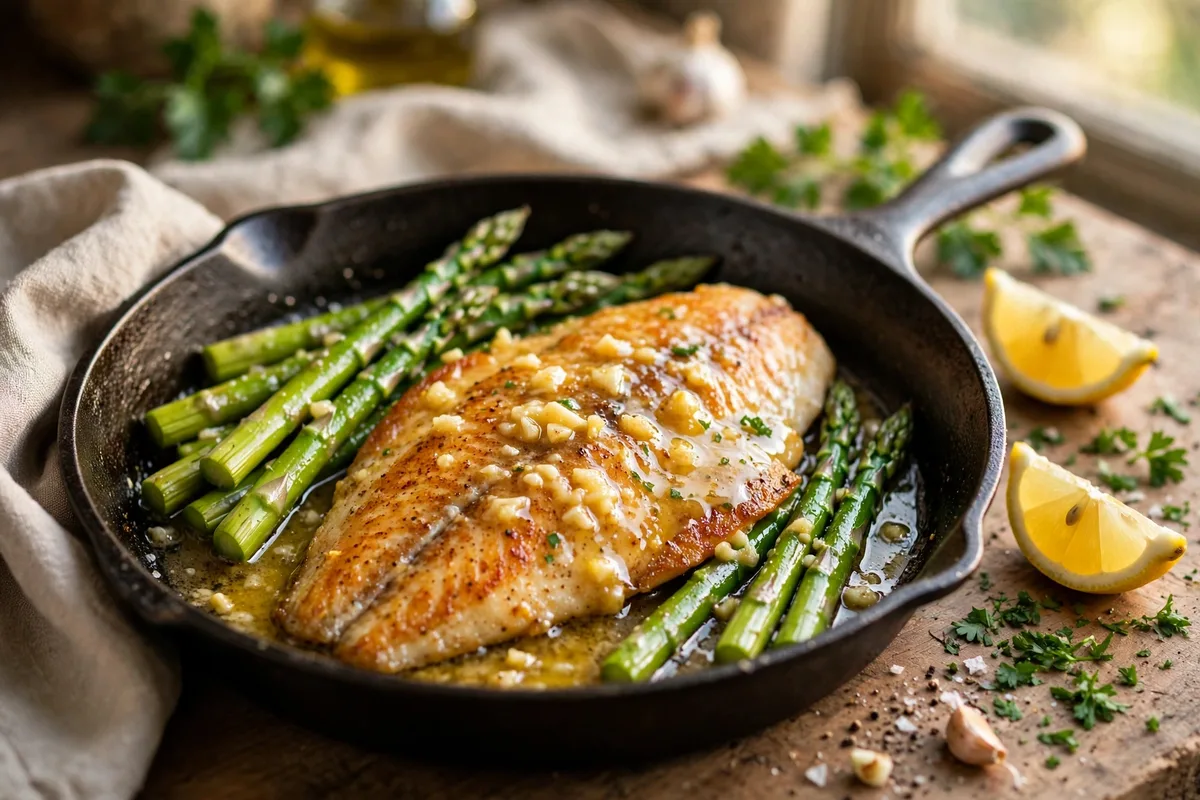
One-Pan Lemon Butter Tilapia with Asparagus (30 Minutes)
This one-pan lemon butter tilapia gets dinner on the table in about 30 minutes, with a single skillet doing all the work. Tilapia fillets are pan-seared until golden, lifted out, and asparagus is sautéed in the same pan before everything comes back together in a garlic lemon butter sauce. There is no oven step at all: the whole dish happens on the hob, and the pan sauce takes about two minutes. Serve it with lemon wedges and crusty bread for mopping up the sauce.
Tilapia is one of the fastest weeknight fish dinners there is, because a fillet cooks in about three to four minutes per side rather than the ten to fifteen a thick salmon fillet or a chicken breast needs. That speed is also the risk: tilapia is thin and delicate, and it goes from perfectly flaky to dry and broken in about a minute if the pan is too cool, the fillet is wet, or it is moved around. This version is built around that problem. The fillets are patted very dry, seasoned simply, and left alone while they sear. They come out before the asparagus goes in, so neither overcooks, and the sauce is built from the browned bits they leave behind. It also fills a real gap in the search results: the freshest page-one result for lemon butter tilapia is a fishing website, not a recipe source, the only food-blog results are weeks to months old, and the one authority result is an oven-baked version from years ago. There is no fresh, food-blog stovetop version — this is it.
Why This Recipe Works
- A true stovetop skillet, no oven. Everything happens in one 12-inch skillet on the hob — the fillets sear, the asparagus sautés, and the sauce comes together in the same pan, with no waiting for an oven to preheat and no second tray to wash.
- Undisturbed searing. Tilapia is thin and delicate, and moving it is the main reason it breaks apart. The fillets go into hot oil and are not touched until it is time to flip, which builds a golden crust and keeps each fillet in one piece.
- The asparagus earns its place. The asparagus is not an afterthought. It cooks in the same pan, picks up flavour from the browned bits the fish leaves behind, and honestly fills the time out to 30 minutes — the fish alone would be done in half that.
- A two-minute pan sauce. Butter, garlic, chicken broth, lemon juice and zest deglaze the hot pan in about two minutes. The sauce is bright and savoury rather than heavy, and it is spooned over the fish at the very end so the crust stays crisp.
- Clear doneness cues. Cook fin fish to 145°F / 63°C, and look for flesh that flakes easily with a fork and has turned opaque all the way through. No guessing, no cutting into every fillet at the table.
Recipe at a Glance
- Prep time: 10 minutes (estimate)
- Cook time: 15 minutes (estimate)
- Total time: 30 minutes (estimate)
- Servings: 4
- Course: Main dish
- Cuisine: American
- Difficulty: Easy
Equipment
- Large 12-inch skillet (stainless steel or well-seasoned cast iron both work)
- Instant-read thermometer
- Fish spatula or wide thin spatula
- Sharp knife and cutting board
- Paper towels
- Measuring cups and spoons
Ingredients
For the tilapia
- 4 tilapia fillets (about 6 oz / 170 g each; 1 1/2 lb / 680 g total), thawed fully if frozen, patted very dry
- 3/4 teaspoon kosher salt
- 1/2 teaspoon black pepper
- 1/2 teaspoon garlic powder
- 1/2 teaspoon paprika
- 2 tablespoons olive oil
For the asparagus and lemon butter sauce
- 1 tablespoon olive oil
- 1 lb asparagus, woody ends trimmed, cut into 2-inch pieces
- 1/4 teaspoon kosher salt
- 3 cloves garlic, thinly sliced
- 3 tablespoons unsalted butter
- 1/4 cup low-sodium chicken broth
- 2 tablespoons fresh lemon juice (from about 1 lemon)
- 1 teaspoon lemon zest (from the same lemon, before juicing)
- 1 tablespoon chopped fresh parsley
- Lemon wedges, to serve
Instructions
- Prep the fish and the pan. If the fillets are frozen, thaw them fully in the fridge overnight or under cold running water, then drain. Lay the fillets on a plate lined with paper towels and pat the tops very dry — a wet fillet steams instead of searing, and this is the single most important step in the whole recipe. Season both sides with the 3/4 teaspoon kosher salt, 1/2 teaspoon black pepper, 1/2 teaspoon garlic powder and 1/2 teaspoon paprika. Zest the lemon, then halve and juice it, so the zest and juice are ready before the pan gets hot. Trim the woody ends from the 1 lb asparagus and cut the spears into 2-inch pieces.
- Heat the skillet. Set a large 12-inch skillet over medium-high heat and add the 2 tablespoons olive oil. Let the oil heat for about 1 to 2 minutes, until it shimmers. The pan needs to be properly hot before the fish goes in — if the oil is not shimmering, the fillets will stick and the crust will not form.
- Sear the tilapia, undisturbed. Lay the 4 seasoned fillets in the pan in a single layer, leaving a little space between them. Do not move them. Cook for 3 to 4 minutes on the first side, until the edges turn opaque and golden and the fillet releases easily when nudged with a spatula. If it resists, give it another 30 seconds — a fillet that is ready to flip lets go on its own. Flip each fillet carefully with a wide spatula and cook for 2 to 3 minutes on the second side. The fish is done when it reaches 145°F / 63°C on an instant-read thermometer at the thickest part and flakes easily with a fork.
- Rest the fish. Transfer the fillets to a clean plate and cover loosely with foil. Do not leave them in the pan while the asparagus cooks — tilapia is thin, and the residual heat would take it past done in a minute or two. Leave the browned bits in the skillet; they are the base of the sauce.
- Sauté the asparagus. Turn the heat down to medium and add the remaining 1 tablespoon olive oil to the same skillet. Add the asparagus pieces and the 1/4 teaspoon kosher salt, and cook for 4 to 5 minutes, stirring occasionally, until the spears are bright green and tender-crisp — a knife should slide in with a little resistance. Thinner spears may need only 3 to 4 minutes; thicker ones may need the full 5.
- Build the lemon butter sauce. Add the 3 cloves thinly sliced garlic and cook for 30 seconds, stirring constantly, just until fragrant — sliced garlic burns fast, so do not walk away. Add the 3 tablespoons unsalted butter and let it melt and foam, about 30 seconds. Pour in the 1/4 cup low-sodium chicken broth, the 2 tablespoons lemon juice and the 1 teaspoon lemon zest. Let the sauce bubble for 1 to 2 minutes, scraping the browned bits off the bottom of the pan, until it has reduced slightly and looks glossy.
- Bring it together. Return the tilapia fillets to the skillet, nestling them among the asparagus. Spoon the lemon butter sauce over each fillet and cook for just 1 minute more, until the fish is warmed through. Sprinkle with the 1 tablespoon chopped fresh parsley, and serve straight away with lemon wedges.
Expert Tips
- Pat the fillets dry twice. Once when they come out of the packet, and once more right before seasoning. Surface moisture is the difference between a golden crust and a pale, steamed fillet that sticks.
- Do not crowd the pan. Four fillets fit a 12-inch skillet comfortably. If your pan is smaller, sear in two batches — a crowded pan drops in temperature and the crust never forms.
- Do not move the fillets while they sear. Every nudge risks breaking a delicate fillet. Let the first side cook until it releases on its own, then flip once and leave it alone again.
- Use a thermometer, not a timer alone. Fillets vary in thickness, and 145°F / 63°C is the finish line. Check the thickest part of the thickest fillet and pull the fish as soon as it reads done — carryover heat finishes the rest.
- Slice the garlic, do not mince it. Thin slices are less likely to burn in the hot pan than minced garlic, and they look better scattered through the finished sauce.
- Season the asparagus separately. The 1/4 teaspoon kosher salt for the asparagus is listed on its own for a reason — the fish already carries its own seasoning, and salting the asparagus in the pan means it is flavoured all the way through.
Variations
- Swap the fish. Cod, haddock, sole or flounder all work the same way — use fillets of similar thickness and keep the 145°F / 63°C target. Thicker cod fillets may need an extra minute per side. Avoid very oily fish such as salmon; the light lemon butter sauce suits a mild white fish best.
- Add capers. Stir 1 tablespoon of drained capers into the sauce with the broth for a briny, piccata-style edge. Reduce the salt on the asparagus slightly, since capers bring their own salt.
- Make it dairy-free. Replace the 3 tablespoons butter with 3 tablespoons olive oil and add the lemon juice off the heat. The sauce will be thinner and less rich, but the lemon and garlic flavour still comes through.
- Add a little heat. A pinch of red pepper flakes stirred in with the garlic gives the sauce a gentle warmth without changing anything else.
- Use green beans instead of asparagus. Trimmed green beans cook in the same 4 to 5 minutes and hold up well in the sauce. This is the easiest swap when asparagus is out of season or expensive.
Serving Suggestions
This is a light dinner, so it pairs best with something that soaks up the lemon butter sauce. Crusty bread is the simplest choice — tear it at the table and mop the pan. If you want something more filling, serve the tilapia and asparagus over rice, orzo or mashed potatoes, and spoon the extra sauce over the top. Set the skillet on the table — this is a dish that looks best served family-style, straight from the pan, with the lemon wedges passed around.
Storage and Reheating
Store leftovers in an airtight container in the fridge for up to 2 days, keeping the fish and asparagus together in the sauce so they do not dry out. Reheat gently in a covered skillet over low heat for 3 to 4 minutes, adding a splash of water or broth if the sauce has thickened, until the fish reaches 145°F / 63°C again. Avoid the microwave if you can — it heats unevenly and can take delicate fish from done to rubbery in seconds. This dish does not freeze well; thawed tilapia turns watery and the asparagus goes limp, so cook only what you plan to eat within two days.
Frequently Asked Questions
How do I know when tilapia is done?
Cook fin fish to 145°F / 63°C at the thickest part, measured with an instant-read thermometer. Visually, the flesh should be opaque all the way through and flake easily with a fork. If the centre still looks translucent, give it another minute.
Can I use frozen tilapia?
Yes, and most tilapia sold in the US is frozen. Thaw the fillets fully before cooking — overnight in the fridge is best, or sealed in a bag under cold running water for about 20 minutes. Never cook them from frozen: they release water into the pan, the crust never forms, and the outside overcooks before the centre reaches 145°F / 63°C. Once thawed, pat them very dry.
Why did my tilapia fall apart in the pan?
The usual causes are a wet fillet, a pan that was not hot enough, or moving the fish too soon. Pat the fillets dry, wait for the oil to shimmer, and do not touch a fillet until it releases on its own. Use a wide, thin fish spatula and support the whole fillet rather than lifting it by one end.
Can I use a different fish?
Yes. Cod, haddock, sole and flounder all work with the same method and the same 145°F / 63°C target — just adjust the time to the thickness of the fillet. Avoid strong-flavoured oily fish, which overwhelm the light lemon butter sauce.
Can I make this dairy-free?
Yes. Replace the 3 tablespoons butter with 3 tablespoons olive oil, added at the same step. The sauce will be thinner and less rich, but the garlic, lemon and browned bits still carry the flavour.
How long do leftovers keep?
Up to 2 days in an airtight container in the fridge, stored in the sauce. Reheat gently in a covered skillet over low heat until the fish reaches 145°F / 63°C again. Do not freeze leftovers — the texture of both the fish and the asparagus suffers badly on thawing.
Can I use white wine instead of chicken broth?
Yes. Swap the 1/4 cup chicken broth for the same amount of dry white wine and let the sauce bubble for the full 2 minutes. It gives a sharper, more aromatic sauce.
Nutrition (Estimates)
The figures below are estimates per serving, based on the quantities in the recipe, for 4 servings. They are not lab-tested values. Per serving: about 380 calories, 44 g protein, 6 g carbohydrates, 20 g fat, 2 g fibre, 4 g sugar, 480 mg sodium. The calculation is internally consistent: 44 g protein × 4 + 6 g carbohydrates × 4 + 20 g fat × 9 = 380 calories. Most of the fat comes from the olive oil and butter in the pan sauce.
Related Recipes
If you like quick one-pan fish dinners, try One-Pan Lemon Garlic Shrimp and Asparagus — the same lemon-and-asparagus pairing with shrimp instead of fish. For a richer weeknight fish dinner, One-Pan Maple Glazed Salmon and Brussels Sprouts Skillet brings a sweet-savoury glaze to a heartier fillet. And if shrimp is more your style, One-Pan Shrimp Fajitas cooks fast in the same kind of skillet, with charred peppers and a quick crema.
Video omitted because no verified, relevant video would materially improve this article.