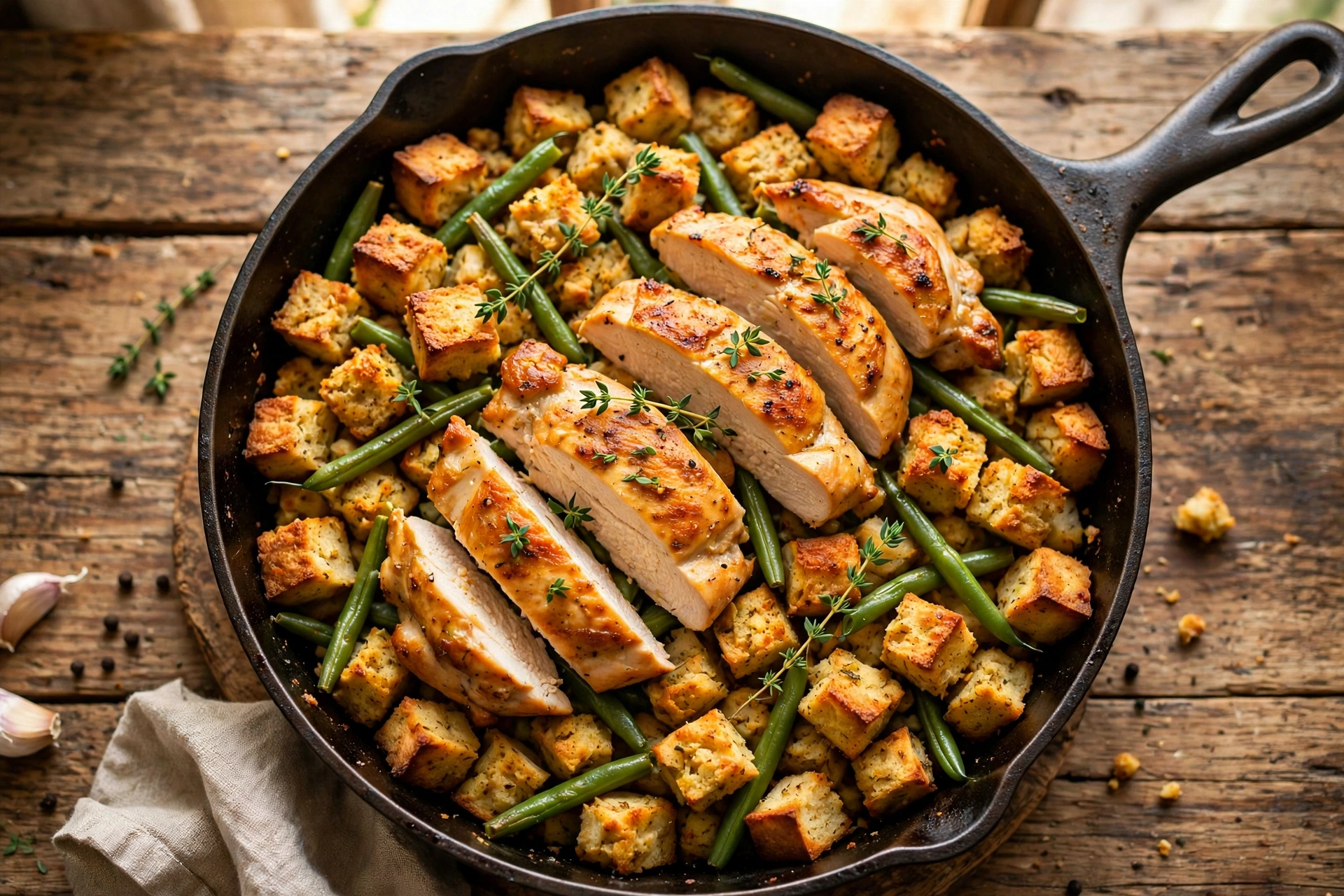
This one-pan chicken and stuffing skillet tastes like Thanksgiving dinner decided to show up on a Tuesday. Juicy chicken pieces, savory bread stuffing, and tender green beans all cook in a single 12-inch skillet in about 30 minutes — on the stovetop, with no oven required. The secret is an honest shortcut: a box of seasoned stuffing mix, which was engineered for exactly this kind of fast, savory side and asks for nothing more than broth and five minutes under a lid.
One clarification, because the name invites it: the "stuffing" here is the bread side dish, not a filling inside the chicken. And this is not our one-pan stuffed pepper skillet — that one wraps seasoned beef and rice in bell-pepper flavor. This skillet is the other comfort-food classic: golden chicken, herby stuffing with crisped edges, green beans for color and freshness, and a light pan gravy tying it all together.
The timing works because everything is cut to cook at the same speed. The chicken goes in as bite-size pieces rather than whole breasts, so it cooks through in minutes instead of demanding oven time. The stuffing mix hydrates in the time the chicken rests. The green beans go in fresh and stay bright. Early November is exactly when this dinner makes sense — it scratches the Thanksgiving itch weeks before the holiday, with a fraction of the effort and one pan to wash.
Prep time: 10 minutes (estimate)
Cook time: 20 minutes (estimate)
Total time: 30 minutes (estimate)
Servings: 4
Why this chicken and stuffing skillet works on a weeknight
Most chicken-and-stuffing recipes are casseroles: layer everything in a baking dish, bake 40 minutes, hope the chicken does not dry out. This version flips the method. Bite-size chicken pieces sear directly in the skillet, which gives you the browned, savory crust that a covered casserole never delivers. Then the stuffing mix goes into the same pan with hot broth, the lid goes on, and the stuffing steams in the chicken's pan juices instead of plain water. Every shortcut in this recipe makes it taste better, not just faster.
The boxed stuffing mix deserves a defense. It is seasoned bread cubes — typically with onion, celery, sage, and thyme already in the mix — designed to hydrate evenly and quickly. Making stuffing from scratch means cubing and drying bread a day ahead, which is a fine weekend project and a non-starter on a weeknight. The box version hydrates in five minutes under a lid and tastes like the holiday side everyone expects. There is no shame in it; there is only dinner.
The green beans are not garnish — they are structural. Without something fresh and green, this skillet would be a plate of beige: browned chicken, browned stuffing, brown gravy. The beans add color, a little bite, and a vegetal freshness that keeps the rich stuffing from feeling heavy. Fresh beans stay crisp-tender in the simmer time; frozen work too, with a note in the variations.
Ingredients
- 1½ pounds boneless, skinless chicken breasts, cut into 1-inch pieces (about 3 large breasts)
- 1 teaspoon kosher salt, divided, plus more to taste
- ½ teaspoon freshly ground black pepper
- ½ teaspoon garlic powder
- ½ teaspoon dried thyme
- 2 tablespoons olive oil
- 1 tablespoon unsalted butter
- 1 medium yellow onion, diced
- 2 celery ribs, diced
- 8 ounces fresh green beans, trimmed and halved
- 1¾ cups low-sodium chicken broth, divided
- 1 (6-ounce) box seasoned stuffing mix (any traditional herb-seasoned variety)
- ½ cup water
- 1 tablespoon all-purpose flour (optional, for a slightly thicker pan sauce)
- 2 tablespoons chopped fresh parsley, for serving (optional)
A note on the chicken: 1-inch pieces are the timing strategy. Whole chicken breasts need 20-plus minutes in a skillet to cook through safely, which breaks the 30-minute promise and dries out the meat. Bite-size pieces cook through in about 6 minutes and stay juicy. Cut them as evenly as you can — uniform pieces cook uniformly.
Instructions
- Pat the chicken pieces very dry with paper towels and season all over with ½ teaspoon of the salt, the black pepper, garlic powder, and dried thyme. Dry chicken browns; wet chicken steams.
- Heat the olive oil in a 12-inch skillet with a tight-fitting lid over medium-high heat until it shimmers. Add the chicken pieces in a single layer — work in two batches if your skillet is crowded. Sear undisturbed for 3 minutes, then flip and sear 2 to 3 minutes more, until golden on at least two sides. Check the largest piece with an instant-read thermometer: chicken is done at 165°F (74°C). Transfer to a clean plate. The chicken will finish in the pan later; what matters now is the browning and the temperature check.
- Reduce the heat to medium. Add the butter to the same skillet — do not wipe it out; the browned bits are flavor. Add the diced onion and celery with the remaining ½ teaspoon of salt. Cook 3 to 4 minutes, stirring occasionally and scraping up the browned bits, until the onion softens and turns translucent.
- Stir in the green beans and 1 cup of the chicken broth. Bring to a simmer, cover with the lid, and cook 4 minutes, until the beans are bright green and just tender-crisp. They will cook a little more later, so err on the crisp side.
- While the beans cook, whisk the remaining ¾ cup of broth with the ½ cup of water in a measuring cup (this is the hydrating liquid for the stuffing; most 6-ounce boxes call for about 1¼ cups total). If you want a slightly thicker pan sauce, whisk the flour into this liquid now — it dissolves better in cool liquid than in the hot pan.
- Uncover the skillet. Scatter the dry stuffing mix evenly over the beans — do not stir it in yet. Pour the broth-water mixture evenly over the stuffing. Return the chicken and any juices from the plate to the skillet, nestling the pieces among the stuffing. Cover with the lid, reduce the heat to low, and cook 5 minutes. The stuffing absorbs the liquid and steams; the chicken finishes gently in the trapped heat.
- Remove the lid and let the skillet sit off the heat for 3 minutes. Fluff the stuffing gently with a fork, folding the chicken and beans through it. The bottom layer of stuffing will have crisped slightly against the pan — that is the best part, not a mistake. Taste and adjust with salt and pepper, shower with parsley if you like, and serve straight from the skillet.
Tips for the best chicken and stuffing skillet
Do not skip the thermometer. Bite-size chicken cooks fast, and "looks done" is not a food-safety standard. An instant-read thermometer in the largest piece, reading 165°F (74°C), is the only reliable check. It takes five seconds and removes all guesswork.
Layer, do not stir, the stuffing. Scattering the dry mix over the beans and pouring the liquid over the top — instead of stirring everything together — is what gives you distinct textures: fluffy stuffing on top, slightly crisped stuffing where it meets the pan. Stirring turns it all into porridge.
Keep the lid on for the full 5 minutes. The stuffing hydrates in trapped steam. Every lift of the lid lets steam escape and leaves dry, crunchy patches in the mix. Set a timer and trust it.
Cut the chicken evenly. A 1-inch piece and a 2-inch piece do not finish at the same time. The small ones dry out while the big ones catch up. Two minutes with the knife at the start saves the whole dish.
The crisped bottom is intentional. Where the stuffing meets the hot pan, it toasts into a golden, slightly crunchy layer. When you fluff with a fork in step 7, fold some of that crispy layer up through the fluffy top — the contrast is what makes people go back for seconds.
Substitutions and variations
Chicken thighs instead of breasts: boneless, skinless thighs work beautifully and are more forgiving — they stay juicy even if they go a minute long. Cut them into 1-inch pieces and cook exactly the same way; confirm 165°F (74°C) with the thermometer all the same.
Frozen green beans: swap them in one-to-one, straight from the freezer, and add 2 minutes to the covered simmer in step 4. They will not stay quite as bright green as fresh, but the texture holds up fine.
Different vegetables: diced carrots can join the onion and celery in step 3 (cut them small so they keep pace); sliced mushrooms go in with the onion for an earthier skillet; frozen peas stir in at step 6 for color without extra cooking time.
Cornbread stuffing mix: a cornbread-style boxed mix swaps in directly and gives the skillet a slightly sweeter, Southern-leaning flavor. The liquid amount stays the same.
Homemade stuffing: if you have day-old bread and a free afternoon, cube and dry 6 cups of bread, toss with sautéed onion, celery, sage, and thyme, and use it in the place of the box. It will not hydrate in 5 minutes the way the engineered mix does — give it 8 to 10 minutes covered — and the recipe stops being a 30-minute dinner. Worth knowing, worth the weekend.
Gravy lovers: double the optional flour to 2 tablespoons and add an extra ½ cup of broth to the hydrating liquid. The pan sauce comes out noticeably silkier and more generous.
What to serve with chicken and stuffing skillet
This is a complete dinner in one pan — protein, starch, and vegetable are all in the skillet — so sides are optional, not required. If you want to round it out, a simple green salad with a sharp vinaigrette cuts the richness of the stuffing, and cranberry sauce on the side leans all the way into the Thanksgiving fantasy (no judgment; it works). Warm dinner rolls are redundant with the stuffing already in the pan — skip them.
For a drink pairing, apple cider — hot or cold — matches the fall-herb flavors better than anything fancy. And if this skillet puts you in the mood for more one-pan chicken dinners, the one-pan apple cider chicken skillet plays in the same autumn sandbox with a completely different flavor, and the hot honey feta chicken brings the sweet-heat contrast. For another 30-minute comfort classic in the same weeknight rotation, our turkey meatballs with gravy deliver the same cozy energy.
Storage, reheating, and make-ahead
Leftovers keep in an airtight container in the refrigerator for up to 3 days. The stuffing absorbs moisture as it sits and firms up — that is normal. Reheat in a covered skillet over medium-low heat with a splash of chicken broth, stirring occasionally, until steaming hot throughout (165°F / 74°C). The microwave works for single portions; sprinkle a tablespoon of broth over the stuffing first so it steams instead of drying out.
Freezing is not recommended. Cooked stuffing turns mushy and the chicken pieces dry out on reheating — the textures that make this skillet good do not survive the freezer. It is a 30-minute recipe; make it fresh.
For make-ahead prep, cut the chicken and dice the onion and celery in the morning and refrigerate them in separate covered containers. At dinner, the skillet work takes about 20 minutes. Do not combine the stuffing mix with liquid ahead of time — it hydrates on contact and will turn to mush sitting in broth.
Chicken and stuffing skillet FAQ
Is the chicken fully cooked in 30 minutes? Yes, because it is cut into 1-inch pieces. Small pieces cook through in about 6 minutes of searing plus the 5-minute covered steam at the end. The non-negotiable step is the thermometer: the largest piece must read 165°F (74°C). Whole chicken breasts would not work on this timeline — the small cut is the whole strategy.
Can I use homemade stuffing instead of the box? You can, but plan for it to take longer. Boxed mix is engineered to hydrate in 5 minutes; homemade dried bread cubes need 8 to 10 minutes covered, plus the day-ahead work of cubing and drying the bread. If you go homemade, the recipe becomes a 40-minute dinner, not a 30-minute one.
Why is my stuffing dry and crunchy in spots? The lid came off too early or the liquid was not poured evenly. The stuffing hydrates in trapped steam, so the lid must stay on for the full 5 minutes, and the broth mixture needs to reach every part of the dry mix. Next time, pour slowly in a spiral pattern over the whole surface.
Can I make this in the oven instead? You can assemble it in an oven-safe skillet and bake at 375°F for 20 minutes instead of the stovetop steam — but that defeats the purpose. The stovetop version is faster, uses one less heating method, and gives you the crisped stuffing bottom that the oven version does not.
Is stuffing the same as dressing? In practice, yes — both are seasoned bread mixtures; "stuffing" traditionally goes inside the bird and "dressing" bakes alongside it. This skillet is technically closer to dressing, since nothing gets stuffed. The box says stuffing, so stuffing it is.
Can I add cheese? It is not traditional, but a handful of shredded sharp cheddar scattered over the top in step 7, lid back on for 2 minutes, melts into the stuffing pleasantly. It moves the dish away from Thanksgiving and toward comfort-casserole, which is a fine place to be.
Can I double this recipe? Not in one skillet — a doubled batch crowds the pan, the chicken steams instead of searing, and the stuffing hydrates unevenly. Make two separate skillets side by side, or accept that the doubled version needs closer to 40 minutes with the chicken seared in extra batches.
Nutrition (estimated, per serving, serves 4): about 480 calories, 14g fat, 42g carbohydrates, 4g fiber, 44g protein. Calculated from ingredient label values; actual numbers vary by the stuffing mix brand and by the size of your chicken breasts.